
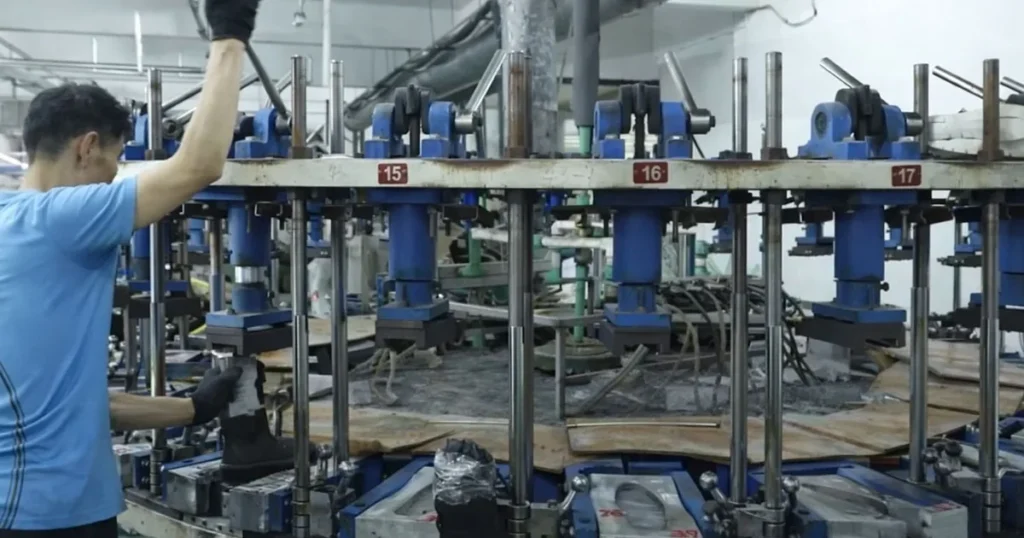
ODM sounds like less work for the brand, and it is, right up to the point where a decision the brand assumed it kept turns out to have been made on the factory floor.
This guide draws the line between what an ODM program transfers to the factory and what stays with the brand, and gives the approval records that keep two ODM quotations comparable.
Direct answer: For an ODM proposal, record who owns or licenses the base design and tooling, and distinguish those rights from execution responsibility; the brand owns the material grade, the color reference, the branding surfaces, the packaging and the approval gates. Write that split into the inquiry, then approve a development sample against a lab-dip and a dimensioned drawing rather than against a photograph.
What ODM transfers to the factory and what stays with the brand
ODM means the factory brings the base design, the last and the construction, and the brand adapts it. Keytop Footwear, founded in Fujian in 2006, develops sneakers, casual shoes, boots, outdoor styles, sandals and slippers, and is not positioned as technical performance footwear, which is itself an ODM boundary worth knowing before a brief is written. That is a real saving on development, and it is also where brands quietly lose decisions they assumed they still held. Ask these five questions before the first quotation, because each one names a decision that has to sit on one side of the line.
| Question to send | Why it matters | Risk it removes | Answer or proof to expect | Buyer follow-up |
|---|---|---|---|---|
| Whose last is this style built on? | The last decides fit, and fit decides returns | Fit defects nobody can trace or correct | Last reference and who owns it | Record the reference on the order |
| Is this base design exclusive to us? | ODM bases are usually shared across buyers | Risk of the same shoe on a competitor shelf | Written statement of exclusivity or none | Decide whether exclusivity is worth paying for |
| Which construction is quoted? | Price differences trace to build, not material | Comparing two quotes for different shoes | Named construction on the specification | Require both quotes to name the same build |
| Who signs off the development sample? | A sample approved verbally is not approved | Production starting on an unapproved shoe | Named approval gate with a signature | Make release conditional on it |
| Which quality records come per lot? | Records made on request tend not to exist | A dispute with no documentary basis | List of records issued per production lot | Name them in the purchase order |
The exclusivity question is the one brands skip and later regret. Confirm the ownership, permitted use and exclusivity of the proposed base in writing; an inquiry alone does not establish exclusivity or transfer tooling rights. Ask early, price it, and decide. Inspection basis matters too: ISO 2859-1 sampling inspection by attributes is the sampling standard many footwear inspection reports reference, and a pass quoted without one is an opinion rather than a result.
A brand is best served by ODM when the factory’s existing design and tooling can be reused, while OEM is the right choice when the drawing itself is the asset the brand must own. When to choose which turns on three inputs: who holds the design IP, who pays for the mold, and whether the size run changes between seasons. Weigh those trade-offs before the RFQ so the quotes compare the same route.
How to approve an ODM development sample before bulk
A development sample is the last cheap moment in an ODM program. Judge it against a written sheet rather than against a memory of the last call, and approve the specification lines rather than the overall impression.
| Specification | Value or range to confirm | Risk if left open | Verification check | Buyer follow-up |
|---|---|---|---|---|
| Last reference | Reference number recorded on the sample tag | Fit changes silently between rounds | Match the tag to your approval sheet | Reject an untagged sample |
| Construction | Named build, not a description | Two suppliers quoting different shoes | Inspect the bond or stitch line | Print the build on the order |
| Material grade | Grade named on a certificate | A substituted grade nobody detects | Read the certificate against the sheet | Attach it to the approval record |
| Size and grading basis | Base size plus the grading rule | A size run that fails in the market | Measure the graded pair, not the base | Approve the graded pair |
Approve a graded pair rather than the base size alone, because grading is where an ODM base most often diverges from a brand expectation, and a regrade after approval is a tooling and cost question rather than a correction. Quantity belongs to the same conversation: at KEYTOP the minimum on casual sneakers, casual shoes, boots and outdoor footwear is 1,000 pairs for one style, one color and one size, and styles, colors and sizes cannot be mixed to reach it, so a four-size approval is not a four-size order. Ranges are set out in the casual shoes products.
Whatever the specification says, the delivered lot is judged by the acceptance basis the order names. Many footwear purchase orders reference the ISO 2859-1 sampling inspection standard, and a stated sampling plan still needs matching specification, sample and actual inspection records before execution can be assessed.
Which branding surfaces survive shoe production
A logo that looks right on a flat artwork sheet behaves differently once it is applied to a curved upper that flexes several thousand times. Choose the surface and the method together, because the cost sits in the method.
| Branding surface | Best fit when | Cost and risk it carries | Verification check | Buyer follow-up |
|---|---|---|---|---|
| Molded into the outsole | The style has its own mold already | Tooling spend, and a change needs new tooling | Check the mold drawing before cutting | Fix mold ownership in the order |
| Debossed or embossed on the upper | Leather or synthetic uppers with body | Depth varies with material batch | Inspect depth on the graded sample | State an acceptable depth range |
| Heat transfer or print | Fast changeovers and small color runs | Edge-lift defects after repeated flexing | Flex-test the sample, do not just look | Require a flexed sample photograph |
| Woven or stitched label | Textile uppers and visible brand marks | Placement variation between size runs | Measure placement on two sizes | Fix placement from a datum point |
Flex is the test that separates these. A print that survives handling can still lift at the vamp crease, which is a defect the buyer sees and the inspection sheet does not, so ask for the flexed sample rather than the fresh one. Application routes are described in the footwear sourcing solutions.
How to lock materials and color references on an ODM order
Material and color are the two specification lines that drift most between a development sample and a production lot, and both are fixable with a reference rather than a description.
Material grade and color reference
Name the material grade and the backing rather than describing the hand feel, and record a color reference the factory can measure against. Two suppliers quoting soft leather will not quote the same leather, and the difference shows up as a cost gap that looks like a discount. Ask which grade is on the certificate supplied with the sample, and check that the same grade is named on the production specification.
Lab-dip approval and tolerance
Approve a lab dip before bulk material is committed, and state the tolerance you will accept rather than approving a single swatch. Color moves with material batch and with finishing, so an approval with no stated tolerance becomes an argument at inspection. Ask for the lab dip on the actual material rather than on a substitute, and keep the approved swatch under a reference the quality control team can pull during the run.
Which packaging and carton marks an ODM order must approve
Packaging is approved last and complained about first. It is also the part of an ODM order most likely to be changed informally between runs, and the part where a rework cost lands on the factory floor rather than in the quotation.
Box artwork and inner packing
Approve the box artwork against a version reference, and specify the inner packing separately: tissue, stuffing, silica and the shoe pairing method all affect how the product arrives and none of them appears on the shoe specification. Check the packed sample rather than the loose shoe, because a box that fails on a pallet passes every check applied to the product inside it.
Label placement and carton marks
Fix label content, language and placement from a stated datum, then fix the carton mark content separately with the consignee. Warehouse rejections often trace to carton marks rather than product quality, and the quality control check that catches them is a photograph of the printed carton from the sample run rather than a proof on screen. Reissue the mark sheet whenever the consignee changes.
For odm shoes, use private label footwear programs to align the product baseline, sample evidence, packing record, and quote owner before order release.
In conclusion
An ODM shoe program runs well when the ownership line is written down. The factory brings the base design, the last and the construction; the brand brings material grade, color reference, branding method, packaging and the approval gates. Everything that goes wrong later is usually a decision nobody assigned.
Ask about base-design exclusivity early, because it is a commercial question rather than a technical one and it gets more expensive after launch. Approve a graded pair rather than a base size, require the flexed sample before signing off branding, and read an inspection pass against the sampling plan behind it. The cost of skipping those steps is not usually a rejected lot; it is a slow drift between what was approved and what ships, which is harder to argue about.
When the split is agreed, take the specification to the OEM and ODM footwear manufacturing and request the quotation there. That route fits because the development stages, tooling questions and approval gates a specification has to reference are described on it, which a general inquiry form cannot resolve. Sending a reference photograph alone risks a quotation built on the factory assumed construction rather than yours.
ODM shoes FAQ
Which decisions transfer to the factory when a brand buys odm shoes?
The proposed base design, last and construction define the development route. Confirm their ownership, permitted use and any exclusivity in the actual agreement, then identify which modifications and approvals stay with the buyer. Do not assume that the term ODM settles tooling or design rights on its own.
What stays with the brand under an odm shoes program?
Material grade, color reference, branding surfaces and method, packaging, and every approval gate. If the brand does not specify those, the factory will decide them by default and the quality control record will reflect the factory choice.
How can a buyer keep two odm shoes quotations comparable?
Make both name the same construction, the same material grade and the same size run before comparing price. Gaps between two ODM quotes often trace to a different build rather than a different margin.
Which sample and specification records should an odm shoes buyer request?
A tagged development sample carrying the last reference, the material certificate, the approved lab dip with its tolerance, a flexed sample showing the branding, and a photograph of the packed unit. Check each against the approval sheet rather than filing it.
RFQ handoff: Send Specs for Review.