
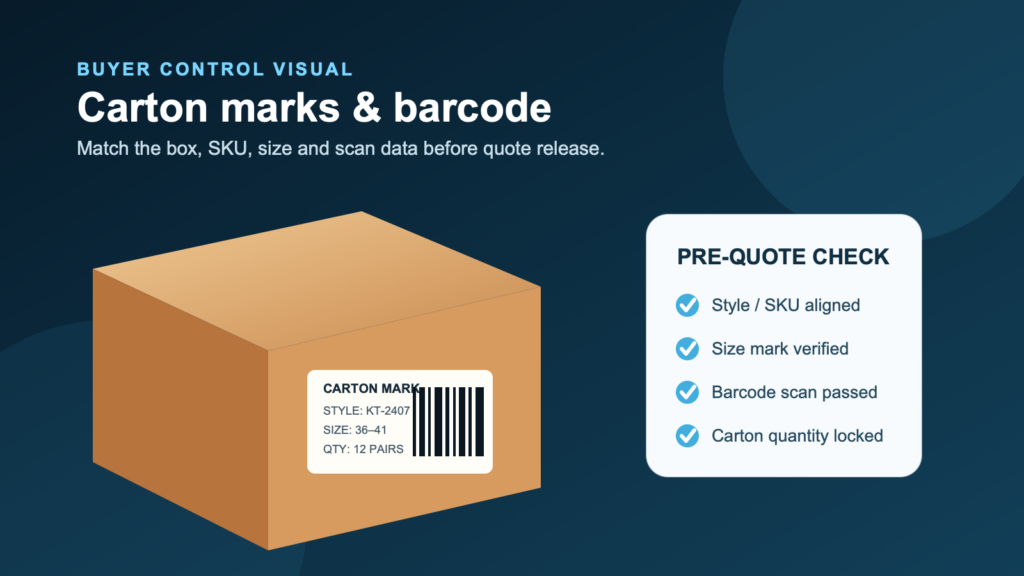
A retail shoe order needs a written carton-mark and barcode specification before the buyer contacts suppliers; otherwise suppliers may quote different product and approval assumptions. At KEYTOP, samples take 7–15 days after sample requirements are confirmed, and standard production takes 35–45 days once specifications, sample approval and the production slot are confirmed.
A carton mark identifies a carton or shipment to the receiving party. Barcode symbology means the barcode type; encoded data means the identifiers and other information carried by that barcode.
Carton marks are often checked after the goods leave the factory, not only at the factory. Agreeing the barcode and shipping mark before production helps reduce the risk of relabeling.
Direct answer: For carton marks and barcodes on a retail shoe order, prepare the RFQ by locking measurable specifications, sample evidence, packing details, quantity terms, and approval checkpoints before requesting a supplier quote.
Why Carton Mark Verification Comes First
Carton identification must be controlled before a shoe supplier prices labels, printing and packout. The quotation should cite the same mark revision that the buyer will scan, inspect and approve.
| Requirement | Factory control | Evidence to verify | Order risk | RFQ follow-up |
|---|---|---|---|---|
| PO, style, color, size range, quantity and destination fields on the outer mark | Print from one approved carton-mark revision | Cross-check marked-carton artwork against the purchase order | Wrong fields cause warehouse misrouting or receiving delay | Approve one numbered artwork revision |
| Barcode symbology, encoded data, placement and label material | Print using production equipment and controlled data | Scan at intended size and contrast | Unreadable data can trigger retail or warehouse rejection | Record the scan result before bulk printing |
| Pairs per carton, assortment and inner-label mapping | Pack from the signed assortment layout | Reconcile physical contents to mark data | A mismatch creates quantity or assortment claims | Sign the packout sample |
| MOQ by label version, lead-time start and QC scope | State the line-by-line commercial assumptions | Compare assumptions across suppliers | Open scope creates repricing or schedule drift | Return incomplete quotations |
Distinguish an ordinary scan from verification against agreed symbol-quality and data requirements. The GS1 barcode-verification guideline is a method reference; the buyer’s current receiving profile remains the source for the required identifiers, symbology, placement and acceptance values.
Use the table as the quote-preparation checklist: freeze the required fields, name the buyer verifier and keep the scan record with the approved carton sample.
The mark artwork, scanned label and physical packout should all carry a traceable approval reference. If the purchase order, barcode data or assortment changes, identify which record is obsolete instead of circulating two active versions.
Before bulk printing, perform a final cross-check using production-intent label material and the actual carton surface. Document any scan failure, data mismatch or placement conflict, assign a correction owner and approve the corrected output in writing.
Key Buying Factors for Carton Marking
Obtain the actual retail buyer’s carton-mark, label and data profile before costing. Specify which fields must be human-readable, which belong in the accepted barcode and which are linked through the buyer’s receiving records; do not assume every PO, style, color, size and quantity field must be encoded together. Verify the identified production label and packout against that profile.
Here is a practical checklist for buyers to include in their RFQ to ensure carton marking meets retail compliance:
- Specs: Confirm barcode symbology (e.g., Code 128 or GS1-128) and label placement (e.g., top right corner of carton).
- Cost or MOQ: Ask the factory: ‘What is the per-carton cost for a pre-printed barcode label versus on-demand printing?’ This reveals whether they absorb setup or pass it on.
- Production Risk: Require a sample of the carton mark from the first production run. Verify that the barcode scans correctly with a handheld scanner before bulk packing.
- Factory Execution: Request a photo of the carton mark on the actual carton, not a mockup. Check for smudging, alignment, and contrast.
- quote request/Sample Handoff: Include a clause: ‘Factory must submit a carton mark sample for approval before mass production. Any deviation requires written buyer consent.’
For example, a barcode printed on a glossy label can reflect scanner light and make cartons unreadable, which leads to relabeling and delay.
- Barcode readability: Can you provide a scan test report from your warehouse system?
- Label durability: Will the label withstand humidity and handling during transit?
- Data accuracy: Does the barcode match the packing list exactly?
- Compliance: Does this meet the retailer’s carton marking specification?
By embedding these verification steps into the quote request, buyers reduce the risk of costly rework and ensure that carton marks become a seamless part of the order fulfillment process. For product context, see our casual shoes products line.
RFQ checkpoint
Share the selected shoe, quantities by variant and the buyer’s carton-mark, barcode and receiving requirements for review.
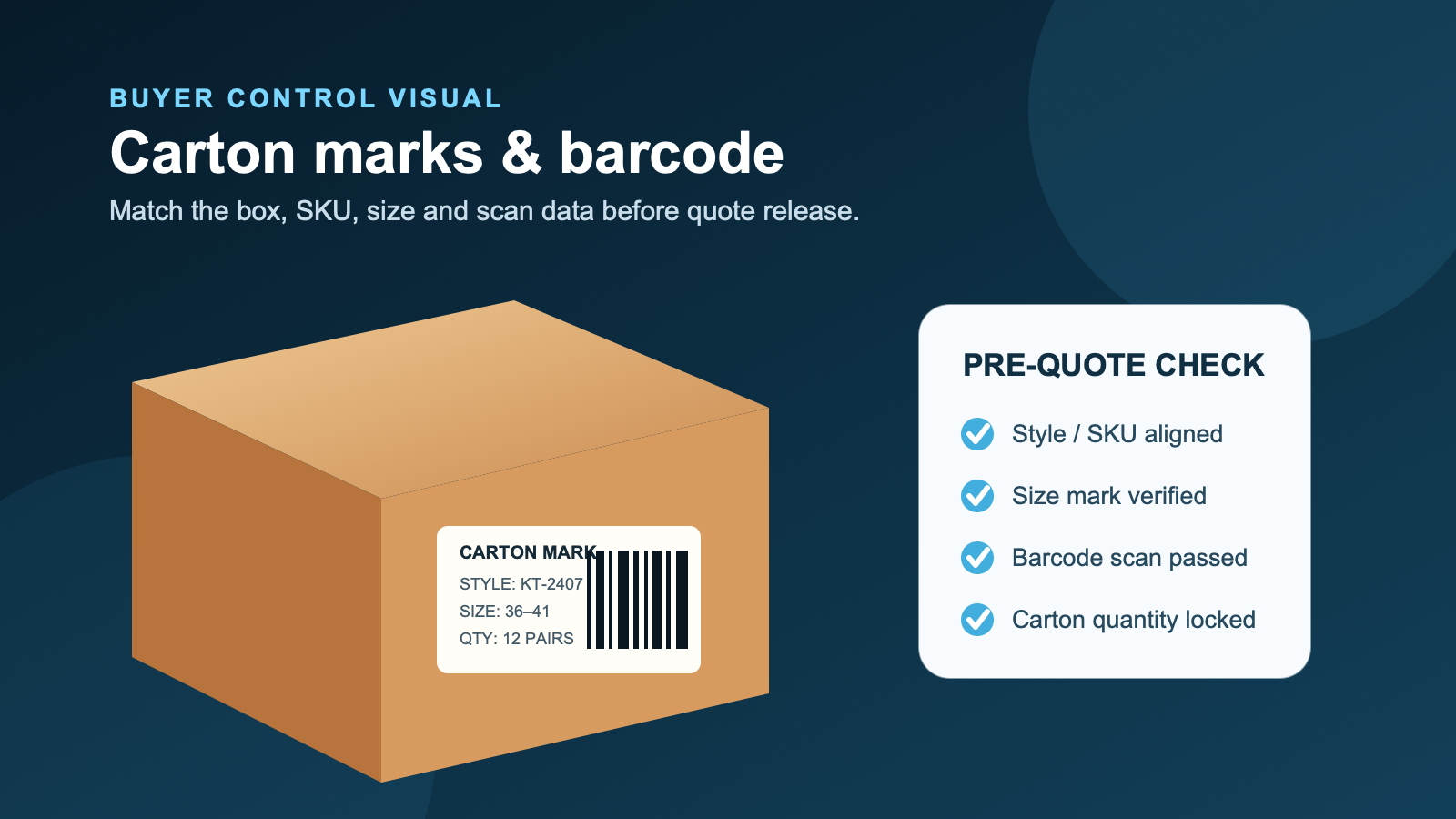
Questions for Comparing Carton-Marking Suppliers
For a footwear products order, treat the carton mark options below as a release rule: approve only when the supplier evidence matches the written requirement.
- How will the barcode be verified? Agree the buyer’s data and print-quality requirements and identify the competent in-house or external verification route. Retain the production-intent label, method, result and any failed or corrected checks. A verifier location or one successful handheld scan alone does not guarantee every label will satisfy receiving requirements.
- What is your process for printing and applying carton marks to ensure alignment and durability? Misaligned or smudged marks cause scanning failures; a clear process indicates the supplier can meet retail compliance standards consistently. Supplier uses thermal-transfer or direct-print methods with a documented alignment check and a durability test (e.g., rub or tape test) before packing. Poorly applied marks can peel or fade during transit, making cartons unidentifiable at the warehouse and delaying your retail distribution. Ask for photos of their print station and a short video of the application process on a recent carton run.
- Can you return a production-intent marked carton? Ask for the current label, substrate, placement and packout proof, and agree its actual preparation and review dates with the packaging source. The confirmed footwear sample range does not automatically establish a carton-printer schedule. Keep the proof and open data questions with the order before bulk packing.
Common Carton Marking Mistakes
When a buyer receives a shipment of sports shoes, the first verification point is the carton mark. A mismatch between the specification on the tech pack and the actual carton label can trigger a costly re-sorting or return, especially when the barcode does not match the retail SKU. This commercial consequence is often rooted in an unclear specification or an incomplete quote request revision.
Material and specification fit
Ensure the carton material and printing specifications are confirmed during the quote request stage. A common mistake is assuming the factory will use the same substrate as a previous order. Ask the supplier to provide a pre-production carton sample with the exact barcode and mark placement before mass production begins.
MOQ, cost structure, and lead time
Verify the cost structure for carton printing, including any setup fees for custom barcode labels. The MOQ for cartons may differ from the shoe MOQ. Confirm the lead time for carton production separately, as delays here can hold up the entire shipment. Use a buyer verification question: ‘What is the minimum order quantity for printed cartons, and what is the cost per unit for quantities above that threshold?’
Supplier reliability and quality checks
Factory execution risk increases when carton marks are not inspected at the same stage as the shoes. Implement a quality check that includes barcode scanning and carton mark verification during the final inspection. A reliable supplier will provide a carton mark approval record before shipment. For more on this process, see our OEM and ODM footwear manufacturing.
- Carton material: Confirm substrate and print method; Pre-production sample
- Barcode accuracy: Scan and compare to SKU; Barcode scanner test
- Mark placement: Verify position on carton; Visual inspection against spec
- Cost confirmation: Include setup fees in quote; quote request revision
By addressing these common mistakes, you can reduce the risk of shipment delays and chargebacks. Always document the carton mark approval in the quote request handoff to ensure factory alignment.
Shortlist Checklist for Carton Marks
Illustrative scenario: a buyer plans 1,200 pairs of casual sneakers in one style, color and size. Before packing, compare a carton proof with the buyer’s receiving specification: carton dimensions, permitted weight, mark content and barcode placement. This is a hypothetical approval exercise, not a reported KEYTOP order.
Decision criteria to confirm
Before placing an order, the buyer must confirm that the carton mark layout includes the required barcode symbology (e.g., Code 128), the correct number of cartons per pallet, and the shipping mark sequence. A mismatch between the quote request and the sample can lead to costly rework.
RFQ details to send
During the quote request stage, the buyer should specify the exact carton mark content, including the barcode format, label size, and placement (e.g., top and side). The factory must confirm that their printing equipment can produce the required resolution and that the label adhesive meets the shipping environment. This helps identify printing or label-stock limitations before bulk packing; the agreed scan check must still be performed on the approved physical proof.
Production handoff details
Before bulk packing, request a carton or label proof made using the intended printing process and label stock. Compare it with the receiving specification and complete the agreed barcode-verification checks. If it fails, identify the cause, correct the artwork, data, printing or placement as applicable, and verify the revised proof. A successful scan alone does not establish that every retailer requirement is met.
See the blog for carton mark checks.
Source scope: Use the GS1 Logistic Label Guideline with the buyer’s actual receiving profile. Lot sampling, print-color references and generic supplier guides answer different questions and do not set the carton’s encoded data or barcode acceptance values.
For carton marks and barcodes, use private label footwear programs to align the product baseline, sample evidence, packing record, and quote owner before order release.
In conclusion
The final approval of carton marks and barcodes on a retail shoe order rests on verifying that every specification—from carton dimensions and weight limits to barcode placement and label content—matches the buyer’s original quote request. Before shortlisting a supplier, compare the quoted cost and MOQ against the checklist’s tolerances, and confirm that the factory can deliver a production-run carton sample that passes a barcode scan test. By documenting each check point and approving the sample before bulk production, the buyer reduces the risk of costly relabeling or shipment rejections at the retail receiving dock.
To request a quote, visit retail footwear sourcing and confirm the final specification, quote assumptions, sample approval, QC evidence, approval risk, and supplier follow-up before bulk order.
File KEYTOP’s ISO 9001 status under company-level quality-management evidence, not as proof that a carton mark or barcode is correct. KEYTOP’s shoe MOQ (1,000 pairs per style, color and size for casual sneakers, casual shoes, boots and outdoor footwear; 1,500 pairs for sandals, slippers and slides) and each packaging-source minimum must remain separate commercial fields.
Frequently Asked Questions
Which carton-mark and barcode details should buyers approve before bulk packing?
Confirm the retailer’s receiving specification, carton-mark text, barcode symbology and encoded data, label placement and the packing/SKU version. Approve a physical carton or label proof and the agreed scan-verification record before bulk packing. Treat changes to the data, artwork or label stock as a new approval rather than relying on a previously accepted label.
Which footwear and packing costs should stay separate in the quote?
The buyer should request a quote that itemizes any setup fees for custom carton printing, per-carton cost, and the minimum order per carton design. At KEYTOP, the shoe MOQ is 1,000 pairs per style, per color and per size for casual sneakers, casual shoes, boots and outdoor footwear, and 1,500 pairs for sandals, slippers and slides; styles, colors and sizes cannot be mixed to reach the minimum. Lead time for samples is 7–15 days after sample requirements and usable specifications are confirmed, and standard production takes 35–45 days after specifications, sample approval, material assumptions, packaging and production slot are confirmed; the buyer reviews these numbers with the factory for the specific order.
What sample, quality, or supplier checks reduce risk?
Before bulk packing, the buyer obtains a production-intent carton or label proof and verifies that the barcode scans correctly, the carton mark content matches the approved layout, and the carton construction meets the retailer’s strength and weight requirements. During the quote request stage, the buyer should specify the exact carton mark content, including barcode type, placement, and any handling symbols, and then document the approved sample. Factory execution risk increases when carton marks are not inspected at the same time as the shoe sample; the buyer should compare the sample approval against the final production carton marks during the pre-shipment inspection. Before comparing carton quotations, agree the artwork approval and packing dates with the shoe-production schedule. Keep carton material and printing setup, footwear quantities, packing service and freight assumptions as separate lines so the buyer can identify what changes the quoted total.
Next step: Send Specs for Review.
Updated October 12, 2026: clarified the buyer approval questions and the hypothetical packing example.