
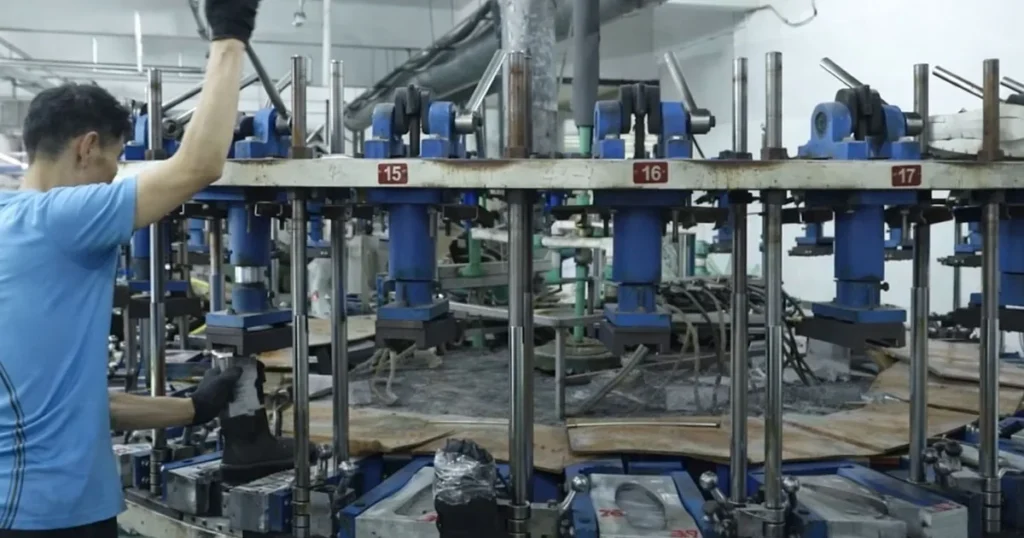
A stated monthly capacity of one hundred thousand pairs tells a buyer almost nothing. What matters is how much of that line is uncommitted inside your delivery window, and whether the window you are offered is shared with another customer’s reorder.
Ask which material, tooling, line operation or staffing condition controls the proposed dates for this order. Record the assigned resources and unfinished readiness tasks against the style and delivery window, rather than inferring an available production slot from a monthly-output or floor-space figure.
The sections below list the capacity evidence to request, how to build a production schedule from it, and how sample, material, and pilot run dependencies sit against the inspection and shipment milestones.
Direct answer: Verify uncommitted capacity inside your delivery window rather than stated monthly output. Ask which lines are assigned, how many moulds exist for your style, what else is scheduled in that slot, and whether any process is subcontracted, then build the schedule backwards from the shipment date.
Copy this shoe factory capacity production schedule verification approval record into the RFQ file. Keep every checked item on the same revision before releasing the order.
- ☐ Final specification and intended use
- ☐ Supplier feasibility and documented exceptions
- ☐ Sample or inspection evidence
- ☐ Commercial assumptions, owner, decision, and date
Move the shoe factory capacity production schedule verification order forward only when each gate leaves written evidence for the next. Return an unresolved specification, sample, or quote exception to its owner before bulk production.
Define the footwear production program
Start with evidence for shoe factory capacity production schedule verification:
- Supplier capability: Verify the factory’s production line allocation for your shoe category and construction method. Request a written line-allocation and capacity statement for the proposed style and material type, then verify the assigned resources and dates.
- MOQ or order quantity: Confirm the minimum order quantity per style, colorway, and size run, not as a single category number. Supplier breaks down MOQ by style and colorway with a clear size-run ratio in writing.
- Quality control: Check the supplier’s QC plan includes incoming material, in-line, and final inspection checkpoints. Supplier provides a dated QC plan referencing your spec revision with named inspection gates.
- Verification method: Compare the supplier’s production schedule against your confirmed sample approval and material readiness dates. Supplier shares a weekly production schedule that ties sample approval, material arrival, and line start to your order.
Also verify that the supplier maintains a single change-control register linking sample ID, spec revision, and packing version. Supplier shows a dated change log with named approval authority for every revision.
Styles, colorways, size runs, and quantities
Define each style, colorway, and size run in your production schedule before the RFQ. A factory that cannot confirm capacity by these variables may overcommit or delay. For example, an order with four colorways in five sizes has twenty colorway-size combinations, and the factory has to allocate upper and sole materials per combination. Without this breakdown, the supplier may assume a single-color production run, causing material shortages or color-mismatch risks at bulk stage.
Tooling and material readiness
Tooling and material readiness determines whether the factory can start production on schedule. Verify that all molds, lasts, and cutting dies are approved and available before the line opens. Confirm that material lead times for upper leather, lining, outsole, and components align with your production window. Record which proposed operations depend on each unresolved tool or material and how that dependency affects the start date.
Ask for capacity evidence
| Criteria | Baseline option | Confirmed option | Buyer meaning | Risk to avoid | Follow-up |
|---|---|---|---|---|---|
| Specification completeness | Standard shoe factory capacity production schedule verification offer using the supplier’s default material, width, and packing route. | Custom shoe factory capacity production schedule verification specification with sample proof and factory confirmation in writing. | This affects quote accuracy, cost, sample approval, quality control, reorder consistency for shoe factory capacity production schedule verification. | Risk includes quote mismatch, unexpected cost, sample rejection, quality dispute, packing error, reorder drift. | Ask for RFQ confirmation, attach proof, and approve only after sample review. |
| Cost driver breakdown | Factory itemizes cost by material, labor, tooling, and overhead per line item | Factory provides a single unit price without breakdown | Itemized cost allows verification of cost drivers against approved spec | Hidden costs for tooling, minimums, or packing changes emerge after sample approval | Require a cost driver breakdown tied to spec revision before shortlisting |
| Quality control plan | Factory provides QC plan with incoming, in-line, and final inspection checkpoints referencing spec revision | Factory relies on final inspection only or no written QC plan | In-process QC catches defects early, reducing rework and delays | Without in-line checks, bulk production may deviate from approved sample | Request QC plan and verify it references the same spec revision and sample ID |
| Sample approval risk | Factory requires signed sample approval record with dated change log before production | Factory proceeds with verbal approval or no formal change control | Signed approval with a change log records the agreed specification for comparison with actual bulk inspection and production records | Unrecorded material substitutions or artwork changes leave the buyer unable to trace whether bulk matches the approved material and artwork revision | Implement a two-gate release: approve product sample and documentation separately |
For specification completeness, a poor decision can mean risk includes quote mismatch, unexpected cost, sample rejection, quality dispute, packing error, reorder drift. Request written proof and compare it with the approved sample or specification, then ask for rfq confirmation, attach proof, and approve only after sample review. For cost driver breakdown, a poor decision can mean hidden costs for tooling, minimums, or packing changes emerge after sample approval. Request written proof and compare it with the approved sample or specification, then require a cost driver breakdown tied to spec revision before shortlisting. For quality control plan, a poor decision can mean without in-line checks, bulk production may deviate from approved sample. Request written proof and compare it with the approved sample or specification, then request qc plan and verify it references the same spec revision and sample id.
For the specification completeness checkpoint in shoe factory capacity production schedule verification, keep the supplier response, marked sample, approved specification, quotation, and approval owner under the same revision number. If the evidence conflicts with the approved record, hold the quote, sample, or production release until the deviation is explained in writing. Carry the signed decision record into the purchase order, production handoff, shipment release, and later reorder review so every team works from the same baseline.
Lines, staffing, and category experience
Verify the factory’s line allocation and staff experience for your shoe category. Ask how many production lines are dedicated to your type and the average tenure of line supervisors. Ask how operator changes are handled through training and process checks, then review the relevant inspection and production records. Request past production records for similar orders to confirm the claimed output per line.
Production-slot and subcontracting questions
Confirm the factory reserves a production slot for your order within your required timeline. Inquire whether any part of the process—such as cutting, stitching, or assembly—is subcontracted. Subcontracting introduces additional lead time and quality control points. Request a written production schedule that shows your order’s position in the line.
See casual shoes products for capacity evidence.
RFQ checkpoint
Confirm the route, specs, proof requirements, and quote step before sampling shoe factory capacity production schedule verification.
Build the production schedule
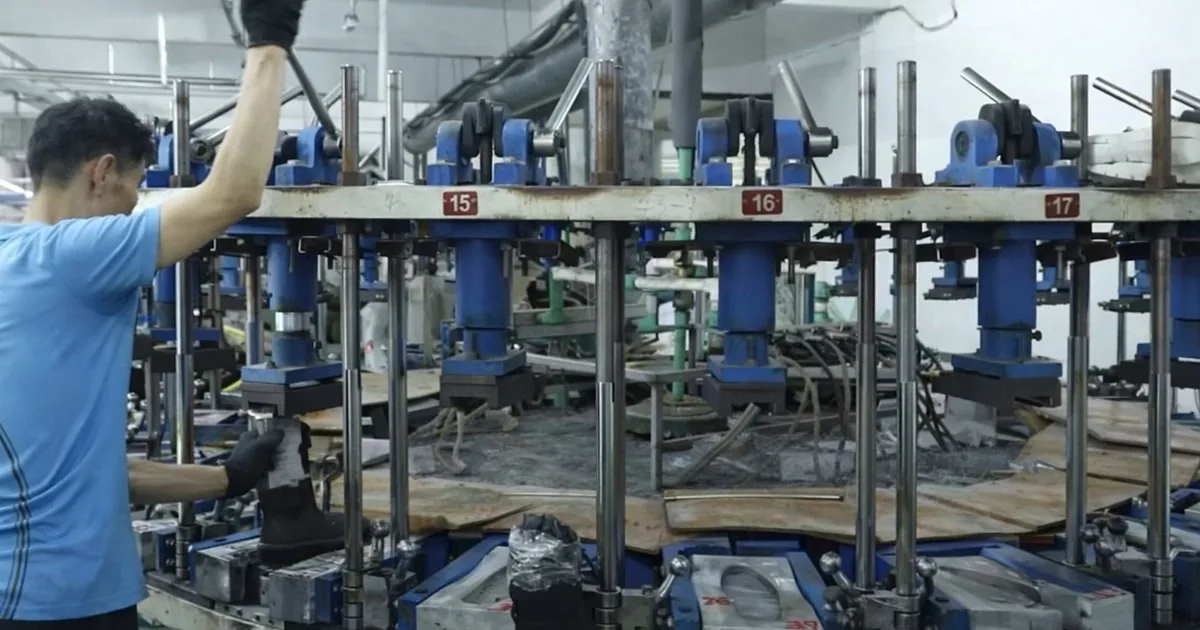
When an unclear specification or incomplete approval record delays the production schedule, the commercial consequence cascades into missed delivery windows and inflated sample iteration costs. A structured production schedule mitigates these risks by aligning every stage from RFQ to final shipment.
Sample, material, and pilot dependencies
Specs must be finalized before material procurement begins. The RFQ handoff should include detailed construction drawings, material grades, and testing requirements to avoid costly re-samples. Pilot runs confirm production feasibility and highlight risks such as last-minute MOQ adjustments or tooling bottlenecks. Factory execution during this phase sets the baseline for the entire schedule.
Inspection, packing, and shipment milestones
Milestones for inspection, packing, and shipment must be tied to the production schedule. Pre-shipment inspection windows should account for transit time and rework. Packing specifications directly affect cost and MOQ, especially for custom packaging. Use the approval records at each gate to identify unresolved dependencies and revise the proposed dates before release. For related product specifications, see the casual sneakers products page.
Stress-test supplier assumptions
Start with evidence for shoe factory capacity production schedule verification:
- What is the factory’s peak-season line allocation and staff tenure for sports shoe production? A factory with high staff turnover or no dedicated line for your category may overcommit capacity, causing schedule slippage.
- How does the factory verify material and tooling readiness before the production start date? Missing molds, lasts, or material lead times can stop the entire line; use the identified readiness records to check the dependencies and proposed dates rather than treating a statement as proof of future execution.
- What is the factory’s documented recovery plan when a production delay occurs? Ask the recovery plan to identify proposed responses to machine breakdown or material shortage, the responsible owner, available resources and expected date changes; review the supporting records before relying on it.
- How does the factory track and report production progress against the agreed schedule? Real-time progress data lets you spot deviations early and enforce corrective actions before the delay becomes irreversible.
Resolve these questions before approval: what evidence does the factory hold that its past orders of similar complexity shipped on time? Review the identified past records for orders with comparable MOQ, style count and material mix, including deviations and actual shipment dates. Those examples do not guarantee that the proposed order will ship on time.
Peak-season and delay risks
During peak season, factories often accept more orders than their line capacity can handle. Ask for the factory’s peak-season order book and confirm your order’s slot is reserved. A delay in material arrival or a machine breakdown can push your shipment past the delivery window. Verify the factory has a documented recovery plan that identifies proposed staffing or material-sourcing responses, their feasibility and their effects on the agreed dates.
Evidence that supports recovery plans
A recovery plan is only credible if backed by evidence. Request past delay records showing the root cause, corrective action taken, and final ship date. The factory should provide a standard operating procedure for common disruptions such as material shortages or line stoppages. Without this evidence, the recovery plan is a promise, not a guarantee. Carry the documented plan into the purchase order as a contractual checkpoint.
Review private label footwear programs before finalizing supplier questions and proof requests.
Compare factories with one scorecard
Use a single scorecard to compare factories when you have at least two qualified suppliers with verified capacity and schedule data. This approach fits when you need an objective, side-by-side evaluation before placing a production order.
Capacity and schedule criteria
Score each factory on these five criteria using a 1–5 scale (5 = best):
- Specs completeness: Are all material, construction, and packaging specs fully documented?
- Cost or MOQ alignment: Does the factory’s pricing and minimum order quantity match your target?
- Production risk: What is the likelihood of delays from material sourcing, labor, or equipment?
- Factory execution: How consistent is the factory in meeting past schedule commitments?
Fifth criterion, RFQ/sample handoff: how clear and timely is the transition from quotation to sample approval?
RFQ inputs and exception log
Before scoring, ensure your RFQ includes: target price, MOQ range, required compliance documents (for example, REACH/SVHC-related documents for EU-market programs), and preferred lead time. During evaluation, log any exceptions—such as incomplete specs or schedule conflicts—in an exception log. This log helps you track risks and decide whether to proceed or renegotiate.
Practical checklist for factory comparison:
- Collect RFQ responses from each factory.
- Score each factory on the five criteria above.
- Review the exception log for unresolved issues.
- Resolve each critical open requirement with its evidence and approval owner before selection. Use the score to describe the remaining documented trade-offs, keeping unresolved exceptions visible beside it.
Document the decision for your team.
For more guidance, visit KEYTOP.
Source check: ISO 2859-1 sampling inspection standard. Record the acceptance rule, evidence owner, and approval step in the RFQ or quality file.
In conclusion
The final approval for a shoe factory capacity production schedule rests on verifying that every checkpoint—specification completeness, cost driver breakdown, quality control plan, and material readiness—is backed by a signed record tied to a single revision. Compare the supplier’s written production slot reservation, sample approval record, and QC plan against the approved spec and sample ID. Shortlist only factories that provide a routing chart matching the approved build and a material control system with locked suppliers. Carry the signed evidence into the RFQ and sample handoff so the same baseline governs bulk production, shipment release, and future reorders.
To request a quote, visit OEM and ODM footwear manufacturing and confirm the final specification, quote assumptions, sample approval, QC evidence, approval risk, and supplier follow-up before bulk order.
Factory capacity FAQ
Why is stated monthly capacity insufficient?
Stated monthly capacity often assumes ideal conditions, but your order’s specific style, colorway, and size run can reduce effective output. For example, an order with four colorways in five sizes requires material allocation per colorway-size combination, and the factory may lack the tooling or line setup for that mix. Verify actual capacity by requesting a written production schedule that shows your order’s slot, line allocation, and staff experience for your shoe category. Confirm that tooling and material readiness align with your lead time, and document any subcontracting risks. Ask how QC will check the sample, color, finish, packing, and bulk order.
What proof should buyers request?
Request a production schedule that includes line reservation, material readiness dates, and past records for similar orders to verify claimed output. Also ask for a capacity evidence pack: specification completeness, cost driver breakdown, and quality control plan, all tied to the same revision number. Confirm the factory has a documented recovery plan for disruptions, and attach these proofs to the RFQ and sample approval record. Use the recorded baseline to compare actual bulk production and later reorder records; the approval file alone does not guarantee consistent execution. Approving the wrong structure or supplier proof can create quality, cost, or delivery problems.
RFQ handoff: For shoe factory capacity production schedule verification, share product size, material, artwork, quantity, sample need, packing method, and deadline so the RFQ can be reviewed before sample approval. Send Specs for Review.