
Slippers slides: product selection needs a written specification before the buyer can decide whether Slippers Slides: Product Selection Checklist fits the use case, specs, MOQ, sample approval path, and supplier quote process; otherwise suppliers may quote different product and approval assumptions.
This guide maps slippers slides: product selection specifications and evidence to comparable sample requests and RFQ (request for quotation) fields.
Direct answer: Use slippers slides: product selection only after its specification, application fit, sample route, quantity rule, and supplier exceptions have been confirmed in writing.
Define the Buyer Requirement
Selecting a slipper or slide starts with the wearing situation and sales promise, because those choices determine construction, material, fit and the evidence a supplier must return. A buyer should lock the use case before comparing samples; otherwise, comfort language can hide differences that affect cost, durability and repeatability.
| Requirement | Acceptance boundary | Commercial exposure | How to verify | Buyer follow-up |
|---|---|---|---|---|
| Use environment | State indoor, poolside, travel, hospitality, casual retail or another defined setting. | The wrong use assumption can produce unsuitable materials, grip, drying behavior or packing. | Ask the supplier to map the proposed construction to the stated environment and list limitations. | Remove options that require claims the supplier cannot substantiate. |
| Product form | Choose open slide, toe-post, closed-toe slipper or another clearly described silhouette. | Comparing different forms as if they were the same product distorts tooling, fit and price. | Approve a side profile, bottom view and construction cross-section. | Keep one form per comparable RFQ line. |
| Fit and size run | Define target market, unisex or gendered fit, size range and reference last or footbed. | A single sample size cannot confirm grading across the range. | Request the proposed size-set check and acceptance points for length, width and strap position. | Hold bulk approval until the agreed fit evidence is signed. |
| Materials and appearance | Record material family, density or hardness target where relevant, color reference, finish and approved substitutions. | Uncontrolled material changes can alter feel, appearance and production consistency. | Compare labeled swatches and components to the approved sample bill of materials. | Require written approval for any substitution. |
| Branding and packing | Specify authorized artwork, logo location, labels, bag or box, inserts and carton marks. | Late artwork and pack-out changes create rework and shipping delays. | Review one complete artwork and packing proof. | Attach approved files to the purchase order. |
When sampling inspections will be used, buyers can reference the ISO 2859-1 sampling inspection standard and separately agree the inspection level and acceptance criteria. Release the requirement only when every field has an owner and a verification method.
Compare Proposed Slipper and Slide Styles
Choose the construction route before choosing cosmetic details. Molded slides, assembled slides and soft closed slippers solve different buyer problems, so their tooling, material controls, fit checks and packing risks should not be collapsed into one price comparison.
| Product route | Best-fit program | Quote and timing drivers | Evidence to request | Exposure if missed |
|---|---|---|---|---|
| One-piece molded slide | Programs prioritizing a simple molded construction and efficient colorway development. | Mold availability, size range, compound, color matching, surface texture and logo treatment. | Request mold ownership, labeled material references, size-set checks and approved color standards. | Unverified tooling or compound assumptions can make the quote non-comparable and create fit or color variation. |
| Assembled slide | Programs needing a separate strap, footbed or outsole for visual and comfort differentiation. | Component count, joining method, padding, prints, trims and additional approval rounds. | Review component specifications, bond or stitch checkpoints and a complete wear sample. | An unfrozen component bill risks substitutions, added charges and bond failures after sampling. |
| Soft closed slipper | Indoor, hospitality or gift programs where textile feel, lining and pack presentation lead the decision. | Upper and lining fabrics, reinforcement, outsole option, size grading and pack-out. | Ask for labeled swatches, construction samples and packing evidence matched to the use case. | Approving only a loose sample risks size, presentation or carton problems during final pack-out. |
KEYTOP’s standard production lead time is 35–45 days after specifications, sample approval, material assumptions, packaging and the production slot are confirmed. Use that range after selecting the construction route, because tooling and material readiness can change the planning sequence.
Confirm mold, compound, size and approval assumptions in the order-specific RFQ.
Buyers can compare the wider footwear products when the program may span several categories, but each slipper or slide line should retain its own construction assumptions and approval record.
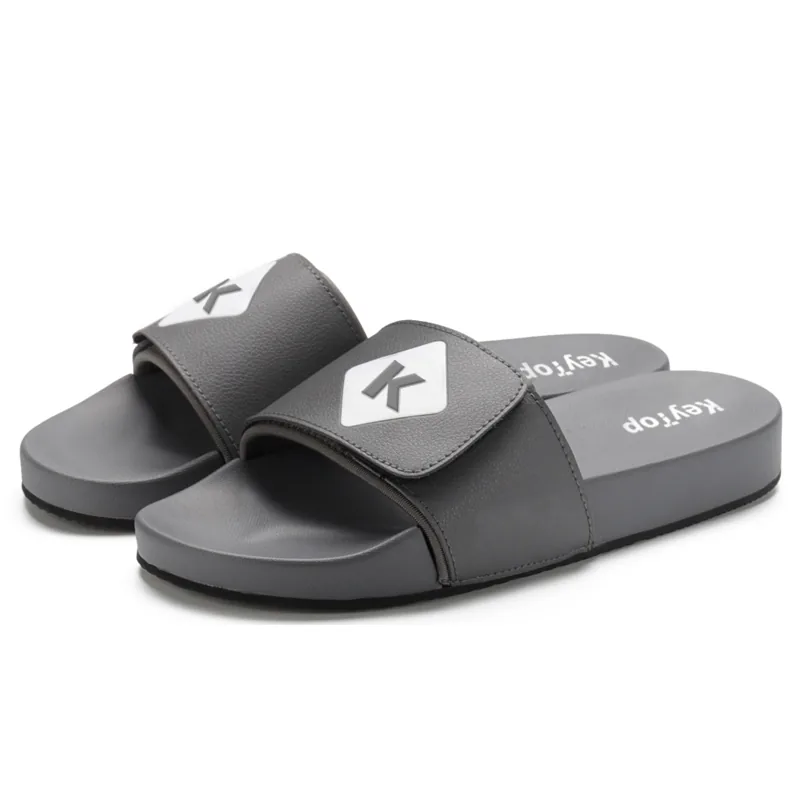
Match Construction Evidence to Each Style
Product selection becomes reliable when the supplier proves that the proposed construction can be repeated across sizes, colors and replenishment orders. Treat a showroom sample as a starting point, then ask for the production controls behind it.
- Construction proof: request a labeled component breakdown, joining method and a statement of which parts use existing or new tooling.
- Material proof: compare approved swatches or molded references with the bill of materials, and define how substitutions will be authorized.
- Fit proof: agree the reference size, size-set plan, footbed length and width checks, and strap or upper positioning controls.
- Appearance proof: use approved color, print, logo and surface-finish references that production and final inspection can access.
- Pack-out proof: inspect one complete retail and shipping configuration, including labels, inserts and carton marks.
- Reorder proof: retain the approved sample, component references and change log so a repeat order is measured against the same baseline.
KEYTOP was founded in 2006. Buyers should still request product-specific material, line, size-set and inspection evidence because company history does not prove that a particular slide or slipper is ready for bulk production.
The applicable solutions can help procurement align evidence with its channel and approval workflow. Keep every proof item attached to the same style code and revision.
Record Slipper Selection and Unverified Features
Convert the selected product route into three approval records that stay with the style. This keeps sales preferences, sample observations and production evidence from drifting into separate conversations.
Supplier evidence to request
Match the factory’s answer to a visible artifact: construction breakdown, tooling status, material reference, size-set plan, inspection record or pack-out proof. If the answer depends on a future test or document, record it as an open condition with an owner and due point rather than scoring it as complete.
Sample approval evidence
Review fit, strap or upper position, surface finish, color, logo, component joining and a complete pack-out against signed references. KEYTOP’s sample lead time is 7–15 days after the sample requirements and usable specifications are confirmed. Plan buyer review and courier transit separately so neither is mistaken for factory sample-making time.
Reorder control records
Retain the approved sample, bill of materials, color and artwork references, packing file and signed deviations under one style revision. For the next order, require the supplier to declare component, material or process changes before pricing and production booking.
KEYTOP’s OEM (original equipment manufacturer) and ODM (original design manufacturer) footwear manufacturing route can provide the commercial handoff for these records. Release the selected route only when all three checks point to the same construction and revision.
Prepare Comparable RFQ Inputs
A comparable quote request asks each supplier to price the same product route, evidence package and approval sequence. Send the construction and quantity assumptions together so low quotations cannot rely on an unapproved material, missing component or incomplete pack-out.
- Which construction and tooling status are included? Ask the supplier to mark existing, modified and new molds, lasts and components. This defines tooling cost and ownership; without it, the buyer risks paying for unavailable or duplicated tooling.
- Which materials and physical references control production? Require labeled swatches or molded references and an approved substitution rule. Material names alone do not control color or feel, so a missing physical reference creates bulk-variation risk.
- How will the size range be verified? Request the reference size, proposed size-set sample, fit checkpoints and the buyer sign-off owner. One approved size does not prove the full grade; if ignored, the buyer risks a range that fits inconsistently.
- What does the quotation include? Separate product, artwork, labels, retail packing, export cartons, tests, sample rounds and freight assumptions. Otherwise the buyer risks comparing totals that cover different scopes.
- Which quality records will be available? Identify incoming-material, in-line and final-inspection evidence and when the buyer can review it. Missing review points create a risk that defects are discovered only after packing.
- What conditions control the production booking? List buyer-supplied files, sample approval, material readiness, packing approval and quantity allocation. An assumed booking date without those conditions creates schedule risk.
KEYTOP’s MOQ for sandals, slippers and slides is 1,500 pairs per style, color and size; styles, colors and sizes cannot be mixed to reach the minimum. Quote each construction, color and size against that condition rather than presenting only a blended project total.
The KEYTOP factory page can support a first capability review, while the returned quote request should remain the source for order-specific inclusions and exceptions. Compare the answers line by line before requesting a final sample or quotation revision.
In conclusion
The completed selection file should identify one use case, construction route, material and fit baseline, sample record, quality-control evidence and reorder reference. Without that shared file, the buyer risks comparing prices for different products or asking the factory to repeat a result that was never fully documented.
Review KEYTOP’s slippers slides products because this route connects the chosen construction to the relevant factory capability and quote request review. Request an assessment by sending the use environment, construction, size run, materials, artwork, packing, quantity, approved sample evidence and target schedule; then approve, clarify or resample before placing the order.
Frequently Asked Questions
How should a b2b buyer choose product type?
Start with the wearing environment, sales promise, target consumer, fit approach and price architecture. Then compare molded slides, assembled slides and closed slippers by construction, tooling, material controls and approval effort. Select the route that the supplier can document and repeat, not the sample that looks most finished in isolation.
Which supplier proof should buyers request for slippers slides?
Request a component breakdown, tooling status, labeled material references, size-set and fit controls, appearance standards, one complete pack-out, inspection records and a change-control process for reorders. Any performance or compliance statement should be matched to product-specific and market-relevant evidence.
What should buyers lock before approving product selection checklist?
Lock the use case, construction route, material and color references, size range, fit checkpoints, logo and artwork files, packing, quotation inclusions, sample approval record, inspection expectations and reorder baseline. Record unresolved items as conditions with named owners before bulk release.
Next step: Send Specs for Review.