










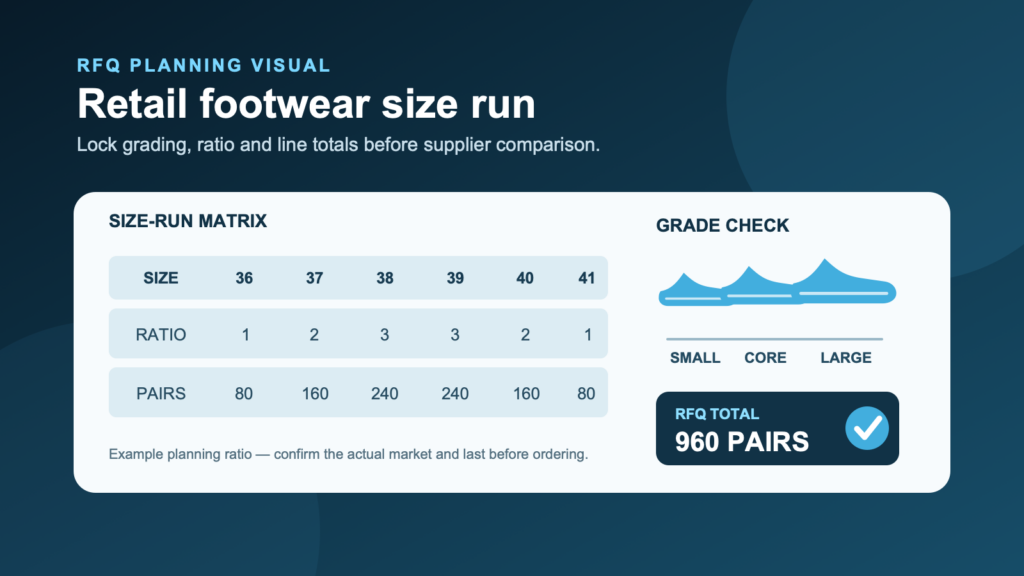
Overseas footwear programs break when fit, size grading, materials, construction, and packing rules live in separate chats instead of one sample record.
On the factory side, useful replies connect intended use, last and fit target, materials, sample evidence, and size-run approval in one record.
The sections below turn those factory decisions into sample checks, supplier questions, and RFQ fields you can put on one revision.
Direct answer: Approve sandal size grading strap length rfq checklist only when intended use, construction or material route, measured sample, packing method, and quote assumptions sit on the same written revision—not when a catalog photo and a unit price arrive in separate chats.
For importers and private-label footwear brands, keep sandal size grading strap length rfq checklist quote-ready: specs to send, proof to request, sample checks to approve, and reorder notes to retain.
Define the Sandal Size Run and Fit Standard
For sandal size grading strap length rfq checklist, compare Define the Sandal Size Run and Fit Standard against one RFQ revision. Each row should identify the requirement, approval evidence, and buyer action before production.
| Specification | Quality control | Verification method | Risk to avoid | Buyer action |
|---|---|---|---|---|
| Sample approval | Signed sample approval form must confirm each graded size meets fit standard; strap length from permanent landmark recorded. | Inspect sample for pressure points, symmetry, and strap-length measurement from toe post center or heel counter top. | Missing signed approval form allows production to proceed with unverified fit, causing bulk rework. | Hold sample approval until supplier provides measurement report for smallest, median, and largest sizes. |
| MOQ and order quantity | Baseline MOQ 1,000 pairs per category; confirm by style, colorway, size run, material, packaging, and production schedule. | Compare supplier quote line items against RFQ size ratio and packing quantity per size; verify tooling amortization terms. | Undisclosed mold amortization inflates unit price if order quantity changes; hidden cost per size increment. | Request itemized tooling costs (mold, last, cutting die) separate from unit price before comparing quotes. |
| Lead time after approval | Bulk lead time 35–45 days after specs, sample approval, material assumptions, packaging, and production slot confirmed. | Request written production schedule that accounts for material procurement and production slot availability; compare to RFQ delivery window. | Supplier cannot commit to delivery window without written schedule; production delays cause missed retail deadlines. | Hold quote and request written production schedule before approving sample. |
For sandal size grading strap length rfq checklist, use Define the Sandal Size Run and Fit Standard as the decision scope. Read the rows as one approval sequence. Start with sample approval because missing signed approval form allows production to proceed with unverified fit, causing bulk rework. Verify it by asking the supplier to inspect sample for pressure points, symmetry, and strap-length measurement from toe post center or heel counter top.
Keep the sandal size grading strap length rfq checklist supplier response, marked sample, and approval owner under the same revision number. If any proof conflicts with the approved record, hold the quote, sample, or production release until the supplier explains the deviation in writing. Before closing the checkpoint, reconcile the latest drawing, sample, quotation, and approval comments, identify which record controls if they disagree, and document the resolution. Carry the signed Define the Sandal Size Run and Fit Standard table into the purchase order and production handoff so the same checks support quote comparison, sample approval, shipment release, and later reorders.
Select selling market and labeled size system
For sandal size grading strap length rfq checklist, use select selling market and labeled size system within define the Sandal Size Run and Fit Standard to connect the fit target, construction specification, sample evidence, and buyer approval record.
Identify core edge and fitting sample sizes
For sandal size grading strap length rfq checklist, use identify core edge and fitting sample sizes within define the Sandal Size Run and Fit Standard to connect the fit target, construction specification, sample evidence, and buyer approval record.
Questions to confirm before ordering:
For sandal size grading strap length rfq checklist, treat the Define the Sandal Size Run and Fit Standard items as RFQ inputs. Match each buyer input to written supplier confirmation, approval evidence, and the risk that would hold the quote.
- Specify the target market's size system (US, EU, UK, JP) and labeled size range in the RFQ. Prevents the supplier from defaulting to a generic grade that mismatches the market's foot-length distribution.
- Document the strap length measurement from a permanent landmark (e.g., toe post center or heel counter top). Ensures repeatability across inspectors and sizes, preventing fit mismatches that require rework.
- Confirm the adjustability overlap range (buckle or hook-and-loop travel) accommodates foot-volume changes across the graded size run. A single strap length for all sizes ignores volume differences, leading to poor fit and returns.
- Verify the baseline MOQ of 1,000 pairs per category aligns with the quotation and production schedule. Ensures the supplier can commit to the order quantity without hidden cost adjustments or delays.
Additional RFQ items include check that the bulk lead time of 35–45 days after sample approval aligns with the supplier's production slot availability. Prevents delivery delays that can disrupt your go-to-market schedule and incur storage or penalty costs.
Build the Footbed and Outsole Grading Table
| Cost driver | What changes it | Quote signal | Risk to avoid | Buyer action |
|---|---|---|---|---|
| Footbed and outsole grading tooling per size increment | Number of size increments and width grades in the size run | Supplier itemizes mold and last costs per size increment separately from unit price | Unlisted tooling costs inflate unit price or cause hidden per-size charges at reorder | Request tooling cost breakdown by size increment and confirm amortization terms before comparing quotes |
| Strap length measurement point and tolerance range | Permanent landmark selection and tolerance width affect inspection time and rework rate | Supplier states measurement landmark and tolerance in the spec sheet, not generic fit claim | Drifting measurements across sizes cause fit mismatches that require bulk rework or returns | Verify supplier documents the landmark and tolerance for smallest, median, and largest sizes before sample approval |
| MOQ per size category and grade run | Number of styles, colorways, and size ratios in the order | Supplier confirms baseline MOQ per category and states whether it applies per style or per colorway | Unclear MOQ allocation leads to minimum charge shortfalls or delayed production slot | Confirm MOQ applies per style and colorway, and document it in the RFQ revision before sample development |
| Lead time for grading sample and bulk production | Spec confirmation speed, sample approval cycle, and production slot availability | Supplier provides separate sample lead time and bulk lead time after specs and sample approval are confirmed | Unrealistic lead time commitments cause missed delivery windows and air freight cost overruns | Obtain written production schedule that accounts for material procurement and slot availability before order release |
For sandal size grading strap length rfq checklist, evaluate Build the Footbed and Outsole Grading Table as one decision scope. Use this cost breakdown table as an approval sequence, not as a supplier claim. For footbed and outsole grading tooling per size increment, a poor decision can mean unlisted tooling costs inflate unit price or cause hidden per-size charges at reorder. Request written proof and compare it with the approved sample or specification, then request tooling cost breakdown by size increment and confirm amortization terms before comparing quotes.
For the footbed and outsole grading tooling per size increment checkpoint in sandal size grading strap length rfq checklist, keep the supplier response, marked sample, approved specification, quotation, and approval owner under the same revision number. If the evidence conflicts with the approved record, hold the quote, sample, or production release until the deviation is explained in writing. Carry the signed decision record into the purchase order, production handoff, shipment release, and later reorder review so every team works from the same baseline.
Confirm length width and increment rules
The footbed and outsole grading table must specify the length increment and width grade for each size in the run. Without documented increment rules, the supplier may grade by a default standard that does not match your target market's fit expectation. Request the supplier to state the increment in millimeters and the width grade system before sample cutting.
Set measurement points and tolerances
Each graded size requires a fixed measurement point, such as the toe post center or heel counter top, to ensure repeatable strap length readings across inspectors. The tolerance range must be stated in the spec sheet and verified against the approved sample. Without this, fit mismatches between sizes will require rework and delay bulk production.
Use solutions to place build the footbed and outsole grading table in the wider buying path.
RFQ checkpoint
Check the product route for sizes, structures, materials, finishes, and RFQ details before sampling sandal size grading strap length rfq checklist.
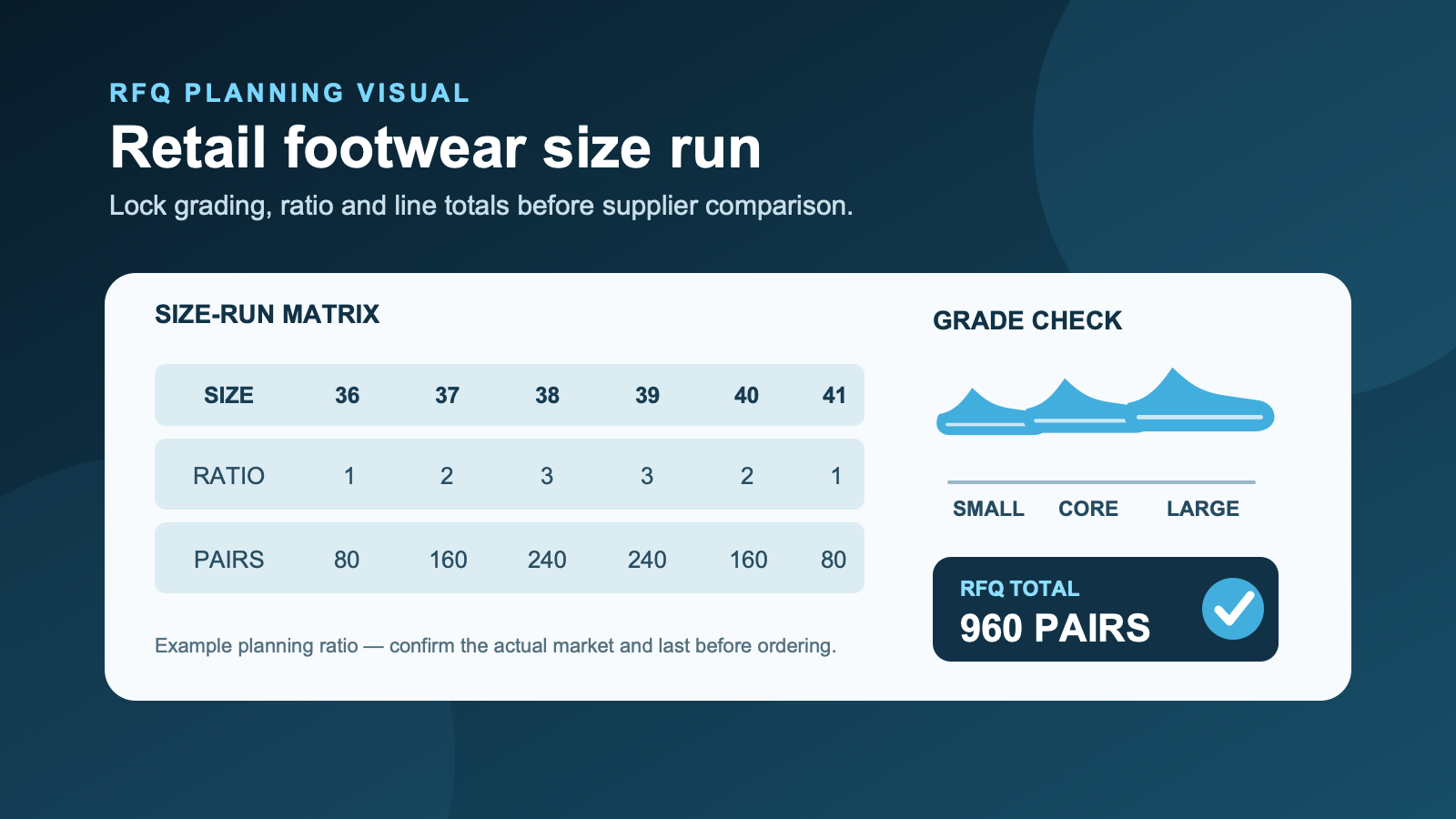
Specify Strap Length and Attachment Geometry
- Supplier cannot name the permanent landmark used for strap length measurement. Without a fixed reference point, strap length varies per inspector, making fit inconsistent across the size run and causing rework. Require the supplier to define the landmark (e.g., toe post center, heel counter top) in the spec sheet before sample development. Written spec sheet stating the permanent landmark and measurement method for each size. Compare the landmark against the approved sample and RFQ, then hold sample approval until it matches.
- Supplier provides only one strap length for all sizes without adjustability overlap data. A single strap length cannot accommodate foot-volume changes across graded sizes, leading to poor fit and returns. Request the strap length for the smallest, median, and largest sizes, plus the adjustability overlap range. Measurement report listing strap lengths per size and the buckle or hook-and-loop adjustment range. Verify the overlap range matches your foot-volume allowance table before approving the sample.
- Supplier claims 'standard fit' without providing a measurement method or tolerance range. Vague fit claims hide grading errors that cause size mismatches, increasing cost for rework and lost sales. Ask the supplier to document the exact measurement method, tolerance range, and reference point for each size. Written fit specification including tolerance range and measurement procedure per size increment. Hold the quote and request written fit specifications before sample approval.
- Supplier cannot provide a photo of the strap at its shortest and longest setting for each size. Without visual proof, the adjustability range may not cover the required foot volume, causing fit failures in bulk. Request a photo of the strap at both extremes for the smallest, median, and largest sizes. Photo evidence showing strap at shortest and longest setting, with a ruler or scale for reference. Compare the photos against the approved spec sheet and confirm the adjustability range before production release.
Measure each strap from fixed reference points
Strap length must be measured from a permanent landmark such as the toe post center or heel counter top to ensure repeatability across inspectors and sizes. Without this fixed point, measurements drift, causing fit mismatches that require rework. Request the supplier to document the landmark in the spec sheet and record lengths for the smallest, median, and largest sizes before sample approval.
Check adjustability overlap and foot-volume allowances
The adjustability overlap range—buckle or hook-and-loop travel—must accommodate foot-volume changes across the graded size run. A single strap length for all sizes ignores volume differences, leading to poor fit and returns. Verify the supplier provides the overlap range for each size and compare it against your foot-volume allowance table before approving the sample.
Use footwear products to align the related specifications and RFQ inputs.
Approve Graded Sandal Samples
At this workflow checkpoint, the buyer must hold a signed sample approval form that confirms each graded size meets the fit standard defined in the RFQ. Without this signed document, production cannot proceed.
Fit-test representative sizes consistently
Ask your supplier to conduct a fit test on at least three sizes from the grade run (e.g., small, medium, large). Each test must use the same foot form or last and record strap length from a fixed reference point, such as the toe post center. Verify that the recorded lengths match the RFQ tolerance (e.g., the buyer-approved tolerance) and that the fit is consistent across the size range. This step reduces the risk of costly rework after bulk production.
Inspect pressure points, attachment location, and symmetry
Examine each sample for pressure points at the toe post, heel cup, and strap junctions. Confirm that strap attachments are located symmetrically on both sandals of a pair. Use a simple checklist during inspection: mark any asymmetry or discomfort. If issues arise, request a revised sample before signing off. This ensures the factory execution aligns with your design intent and avoids production delays.
Below is a summary of key verification points to include in your sample approval form:
| Checkpoint | Buyer Verification Question |
|---|---|
| Strap length consistency | Does each graded size match the RFQ-specified length from the toe post center? |
| Pressure points | Are there any visible or tactile pressure marks on the footbed or straps? |
| Attachment symmetry | Are left and right sandal strap positions mirror images within the approved tolerance? |
| Fit test pass | Have at least three sizes been fit-tested and approved by the buyer? |
Once all checks pass, sign the sample approval form and hand it to the supplier. This document becomes the binding reference for bulk production and final quality inspection.
Use OEM and ODM footwear manufacturing to align the sample and production handoff.
Prepare the Sandal RFQ and Size Ratio
Start Prepare the Sandal RFQ and Size Ratio with evidence for sandal size grading strap length rfq checklist:
- Does the supplier have a documented size grading table that includes strap length measurements from a permanent landmark for each size? Confirms supplier capability to grade strap length consistently across the size run. Supplier provides a grading table with strap length values for smallest, median, and largest sizes from a defined landmark. Supplier may use inconsistent grading, causing fit mismatches and rework. Request the grading table and measurement report before sample development.
- How will the supplier verify strap length across the size run during sample development? Ensures a repeatable verification method is in place. Supplier marks a permanent landmark and measures strap length on each sample size, providing a measurement report. Without verification, grading errors may go undetected until bulk production. Require measurement report with sample submission for the smallest, median, and largest sizes.
- What is the approval risk if the sample approval form does not include strap length measurements? Identifies the risk of approving production without confirming strap length compliance. Supplier confirms that the sample approval form includes strap length measurements from the permanent landmark. Production may proceed with incorrect strap lengths, leading to costly rework or returns. Hold production release until the signed sample approval form includes strap length measurements.
- How will QC check strap length in bulk production to ensure consistency with the approved sample? Verifies that quality control will maintain strap length standards during production. Supplier's QC plan includes checking strap length from the permanent landmark on a defined sample size per lot. Bulk production may deviate from approved sample, causing fit issues. Request the QC plan and inspection report for strap length checks.
Send grading strap material packing and quantity inputs
When preparing the RFQ, specify the strap material (e.g., nylon, leather), width, buckle or hook-and-loop type, and the packing quantity per size. Include the required number of pairs per inner box and master carton. This ensures the supplier quotes for the correct material cost and packing components, preventing hidden adjustments later.
Separate tooling assumptions from unit-price comparisons
Collect the supplier to itemize all tooling costs—molds, lasts, cutting dies—separately from the unit price. Confirm who owns the tooling and how it is amortized across the order quantity. This prevents the unit price from inflating due to undisclosed mold costs and allows accurate comparison across quotes.
Use KEYTOP factory to align the related specifications and RFQ inputs.
Conclusion: Freeze Grading and Strap Geometry Before Quotation
The final approval for sandal size grading and strap geometry rests on one verifiable package: the signed sample approval form that ties the graded size run, strap-length measurements from a permanent landmark, and the adjustability overlap range to the RFQ tolerance. Before releasing production, check that the supplier’s QC evidence—measurement report for the smallest, median, and largest sizes, and a photo of the strap at its shortest and longest setting—matches the approved spec sheet, and confirm the baseline MOQ of 1,000 pairs per category and bulk lead time of 35–45 days align with the quotation. This handoff turns a one-time sample sign-off into a controlled, repeatable practice that protects fit consistency and cost across every size in the order.
To request a quote, visit sandals products and confirm the final specification, quote assumptions, sample approval, QC evidence, approval risk, and supplier follow-up before bulk order.
Sandal Size-Grading and Strap FAQ
How should buyers confirm packed box dimensions?
Only if the supplier has documented the packed box dimensions per size ratio and confirmed they match your carton-loading plan. Request the supplier to measure the master carton for the smallest, mid, and largest sizes, and compare the dimensions against your shipping container’s internal volume. If the supplier cannot provide a packed-box measurement report, hold the quote and request written confirmation of the carton dimensions per size. Ask how QC will check the sample, color, finish, packing, and bulk order.
What should buyers verify before approving sandal size grading strap length rfq?
Before approving the sandal size grading strap length RFQ, verify that the supplier’s response includes exact strap length measurements from permanent landmarks such as the toe post center or heel counter top for the smallest, mid, and largest sizes. Check that the adjustability overlap (buckle or hook-and-loop range) accommodates your foot-volume allowance table, and confirm the supplier has provided a photo of the strap at its shortest and longest setting. If the supplier says “standard fit” without naming the measurement method or tolerance range, hold the sample and request written fit specifications.
Which construction, materials, and outsole direction are expected?
The expected construction includes footbed thickness, outsole density, and strap-attachment points defined in your RFQ. The supplier should confirm the footbed material code, outsole durometer, and strap-attachment method—not generic descriptions like “standard footbed” or “normal outsole.” For the outsole direction, specify the tread pattern orientation and any directional arrows on the outsole drawing. If the supplier cannot provide exact material codes and test results, hold the quote and request written specifications before sample approval.
Which parts can use existing factory resources and which parts need custom development?
Existing factory resources typically cover standard lasts, common outsole molds, and generic strap hardware such as buckles or hook-and-loop. Custom development is needed for unique strap lengths, non-standard attachment points, proprietary footbed shapes, or outsole tread patterns that require new tooling. Request the supplier to itemize tooling costs (mold, last, cutting die) separately from the unit price, and confirm tooling ownership and amortization terms before comparing quotes. If the supplier cannot separate tooling costs, hold the quote and request a detailed cost breakdown. Ask how QC will check the sample, color, finish, packing, and bulk order.